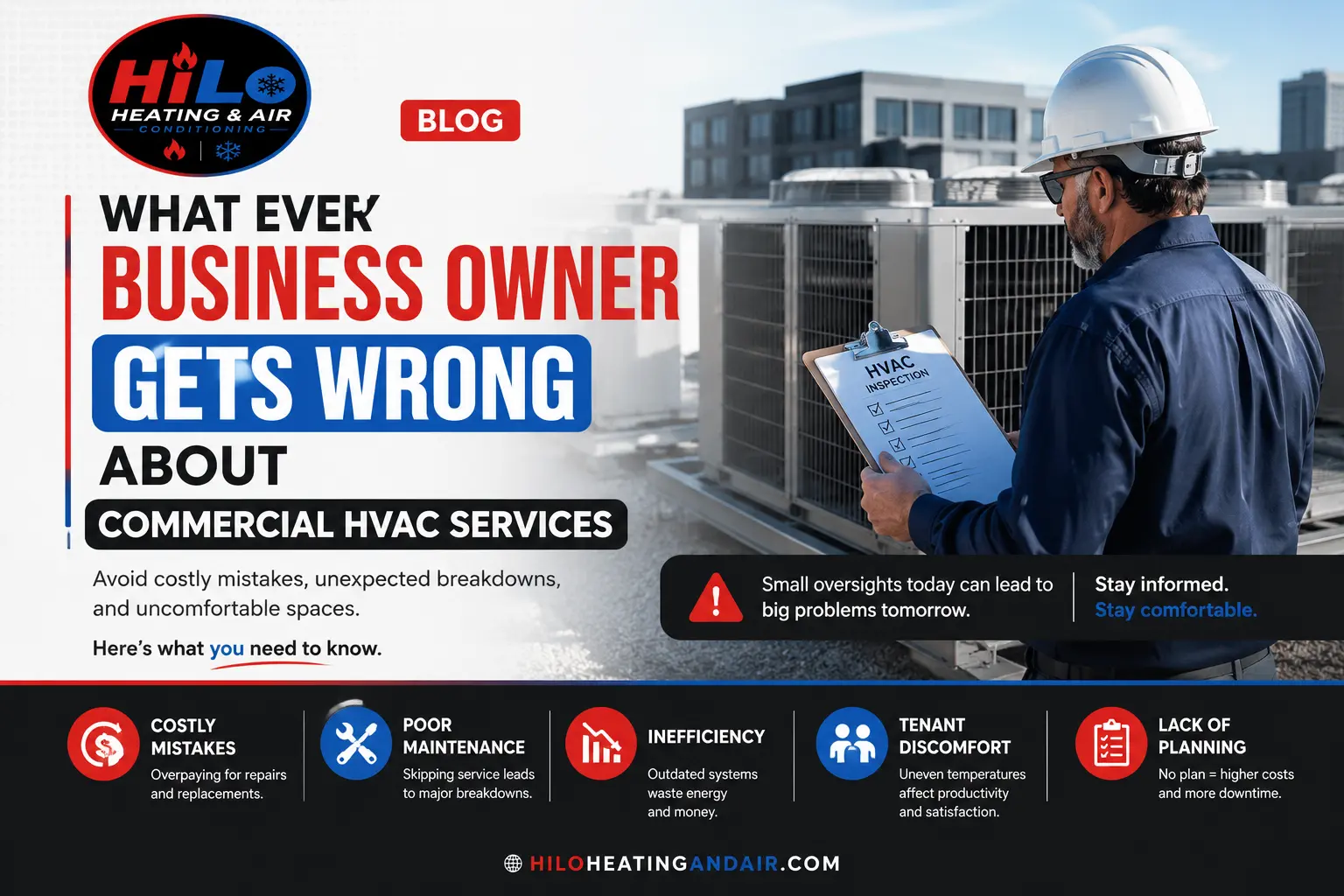

I’ll start with something most HVAC companies won’t say out loud: the majority of commercial system failures we respond to were completely preventable. Not “could have been caught earlier with some luck” — genuinely, obviously preventable. A technician could have spotted the problem three months before it became an emergency. But nobody called until the air stopped working.
That’s the honest reality of how most businesses treat their heating and cooling systems. They’re invisible until they’re not.
At HiLo Heating & Air, we do a lot of emergency calls. We’re good at them. But if we’re being straight with you, we’d rather you never need one.
First — Why Commercial Is Completely Different From Residential
This seems obvious once you say it out loud, but a lot of business owners don’t realize how different commercial systems actually are until something goes wrong and they hire the wrong company to fix it.
Your home AC runs a few hours a day. It’s conditioning maybe 2,000 square feet, accounting for a couple of people and maybe a few appliances. A commercial system is doing something entirely different. It might be running 14 hours a day in a building with 40 employees, commercial kitchen equipment pushing out heat, a server closet that can’t go above 75 degrees, and a customer-facing area that needs to stay comfortable regardless of how many people walk in at noon on a Tuesday.
Rooftop package units, variable refrigerant flow systems, chilled water systems, commercial air handlers — this equipment is bigger, more complex, and wears differently than residential gear. Commercial HVAC services require technicians who actually know these systems, not someone who handles home installs and figures the rest out as they go.
HiLo Heating & Air works on commercial systems day in and day out. That matters more than it might seem.
What Good Commercial HVAC Services Actually Look Like
Here’s where a lot of companies get vague. “Full-service HVAC” can mean almost anything. So let me break down what commercial HVAC services should actually cover.
Scheduled Preventive Maintenance
This is the whole game, honestly. Two to four visits per year — depending on your system type, building size, and how hard the equipment runs — where a technician goes through everything systematically. Refrigerant levels. Coil condition. Electrical connections. Belts. Bearings. Drain lines. Thermostat and controls calibration. Filter condition.
The point isn’t just to clean things. It’s to catch what’s drifting out of spec before it causes a failure. A capacitor that’s testing weak costs $100 to $200 to swap during a maintenance visit. The same capacitor that fails during a heat wave, takes your rooftop unit down, and requires emergency response on a Saturday? That’s a very different number — and that’s before you count what the downtime cost your business.
Repairs Done Right the First Time
When something breaks, speed matters — but accuracy matters more. A fast wrong diagnosis just means you’re back in the same situation two weeks later. Real commercial HVAC services mean a technician who understands the system well enough to find the actual problem, not just replace the most obvious part and hope for the best.
We’ve had clients come to HiLo Heating & Air after another company told them they needed a full system replacement. Sometimes that’s true. Sometimes it’s a refrigerant leak and a bad contactor. You deserve a provider honest enough to tell the difference.
New Installations and System Upgrades
Old equipment gets to a point where it costs more to maintain than it would to replace. That’s a real conversation and a real calculation — not just a sales pitch. When it’s time for new equipment, the installation has to be done correctly. Load calculations, ductwork evaluation, proper sizing — all of it affects how well the system performs and how long it lasts.
An oversized commercial system will short-cycle constantly, wear out faster, and leave humidity problems behind because it doesn’t run long enough to pull moisture out of the air. An undersized one just runs forever and never quite gets there. Neither is acceptable. HiLo Heating & Air sizes systems based on what your building actually needs.
Indoor Air Quality
More businesses are paying attention to this now than ever before, and for good reason. Filtration quality, ventilation rates, humidity levels, carbon dioxide buildup in densely occupied spaces — all of it affects how people feel, how well they work, and in some industries, whether you’re meeting code requirements.
Quality commercial HVAC services include an honest assessment of your air quality situation and practical solutions that fit your building and your budget. Not just the most expensive upgrade on the market.
Emergency Response
Server room temperatures spiking. A restaurant losing cooling in the middle of the dinner rush. A retail store that becomes a furnace at noon and customers start leaving. These situations can’t sit on a waiting list.
HiLo Heating & Air takes commercial emergencies seriously. We know what downtime costs a business, and we work as fast as we can without cutting corners.
The Warning Signs Most Businesses Ignore Until It’s Too Late
You probably already know something’s not quite right with your system. Here’s what that usually looks like:
Energy bills that have quietly climbed over the past year or two. Not a dramatic spike — just a steady drift upward that’s easy to attribute to rates or usage. Often it’s a system that’s losing efficiency because it hasn’t had proper commercial HVAC services in too long.
Temperature complaints from staff in certain parts of the building. One zone’s too cold, another never fully cools down. People adjust. They bring fans. They stop mentioning it. The underlying problem doesn’t go away.
A noise that wasn’t there six months ago. Rattling on startup. A hum from the rooftop unit that’s gotten louder. These sounds are mechanical changes — things wearing, loosening, or failing slowly.
Musty smells when the system runs. Especially in the morning when it first kicks on. That’s biological growth on your coils or in your drain pan, and it’s circulating through your building every day.
A repair history that’s starting to stack up. If you’ve called for service three or four times in the past year, the cumulative cost is telling you something. Sometimes the answer is a maintenance agreement. Sometimes it’s a replacement conversation. Either way, HiLo Heating & Air will give you the honest version.
Picking the Right Provider — What Actually Matters
Ask any HVAC company if they do commercial work and they’ll say yes. Here’s how to actually tell the difference.
Do they have specific experience with your type of system? A company that mostly does residential installs and occasionally takes on light commercial jobs is not the same as a company where commercial work is a core part of the business.
Can they tell you clearly what their response time looks like for emergencies? If they can’t answer that question specifically, you’ll find out the hard way.
Do they offer maintenance agreements with defined scope? A handshake deal is not a maintenance plan. You should know exactly what’s covered, how often visits happen, and what’s included.
Are they upfront about pricing? Emergency rates, after-hours fees, diagnostic charges — these should be explained before you agree to anything.
HiLo Heating & Air has built its commercial business on answering these questions honestly and then actually delivering on them. That’s not a pitch — it’s just how we’ve kept clients coming back.
The Bottom Line on Commercial HVAC Services
Neglected systems lose efficiency every year. Dirty coils, low refrigerant, worn electrical components — none of it stays static. It gets worse. And it gets worse quietly, until one day it doesn’t anymore.
The businesses that spend the least on HVAC emergencies are almost always the ones treating commercial HVAC services as a scheduled, budgeted line item — not a reactive expense. They know what their systems cost to maintain, they plan for it, and they almost never get surprised.
That’s what HiLo Heating & Air wants for your business. Not a one-time call — a relationship that keeps your building running the way it should, year after year.
If you can’t remember the last time your commercial system had a real inspection, that’s worth fixing before summer makes the decision for you.
Get in touch with HiLo Heating & Air and let’s talk about what your building actually needs.